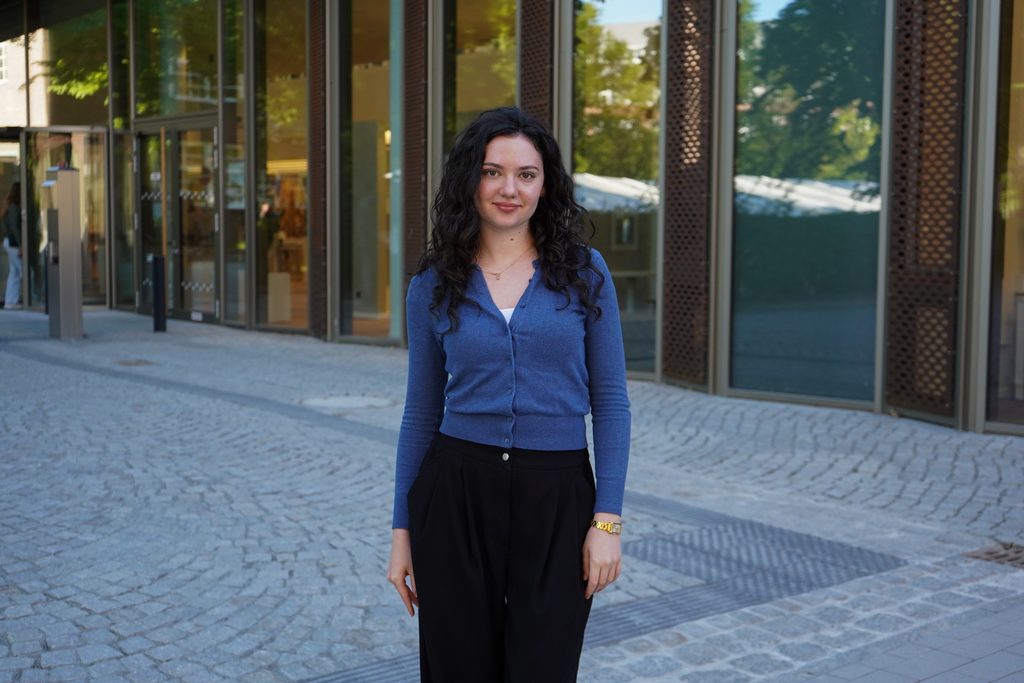
At Kiel University (CAU), Anastasiia Roshchuk, a student of Finance, Banking and Insurance at Kherson State Agrarian and Economic University (KSAEU), is continuing her studies in Germany through a scholarship programme. In an interview recorded in Kiel in May 2026, she reflects on adapting to classroom-based education, living in a new country and the goals she is developing for the future.
Academic and personal opportunities in Kiel
Through the ACTI-K² partnership, CAU and KSAEU work together to support Ukrainian higher education during the war. CAU welcomes students into its academic community in Kiel, while KSAEU supports their participation in international exchange. Funding from the German Academic Exchange Service (DAAD) helps sustain this cooperation, connecting support for Ukraine’s universities with practical opportunities for their students.
For Anastasiia, studying at a German university has meant encountering new teaching formats, cultures and people from many countries. Daily communication has helped her strengthen her English, while living abroad has required greater independence, responsibility and adaptability. Travel to other European countries has broadened the experience further.
University life beyond the classroom has also mattered. She has connected with student and community initiatives, including SONYASHNYK and Rozmova, and has taken part in their development. These activities have given her additional ways to build social connections and engage with Ukrainian life in Kiel.
Adapting to classroom and campus life
One of the biggest challenges was using English constantly in real situations. Even with a strong command of the language, communicating with people who have different accents and levels of fluency required time and practice. “The most important thing is not to be afraid or embarrassed to ask questions, ask for clarification and keep trying,” she says.
A second adjustment was adapting to classroom-based learning at CAU. Because of the war, Anastasiia’s bachelor’s degree programme had followed a hybrid format, combining remote and in-person study. In Kiel, she had to adjust to a different pace of classroom teaching and campus life. The transition was difficult at first, she explains, but it was worth the effort.
She also encountered the complexities of German bureaucracy. Documents and unfamiliar processes could be stressful, but she points to CAU’s International Center as an important source of guidance when questions arose.
Building future plans across disciplines
Looking ahead, Anastasiia hopes to continue developing academically in Germany and is considering applying for a master’s degree at a German university. She is also interested in data analysis and psychology and would like to explore how these fields can complement economics in her future studies and work.
Her experience demonstrates the practical value of German-Ukrainian academic cooperation. The scholarship has enabled her to experience university life in person, build confidence in a multilingual environment and define new academic directions. Her perspective also gives the partnership a personal dimension by showing what international academic support can mean in a student’s everyday life.
