On 13 October 2025, the Faculty of Agricultural and Nutritional Sciences at Kiel University (CAU) and Kherson State Agrarian and Economic University (KSAEU) signed a Memorandum of Understanding (MoU). The agreement provides a framework for closer academic and scientific cooperation in agricultural and food sciences.
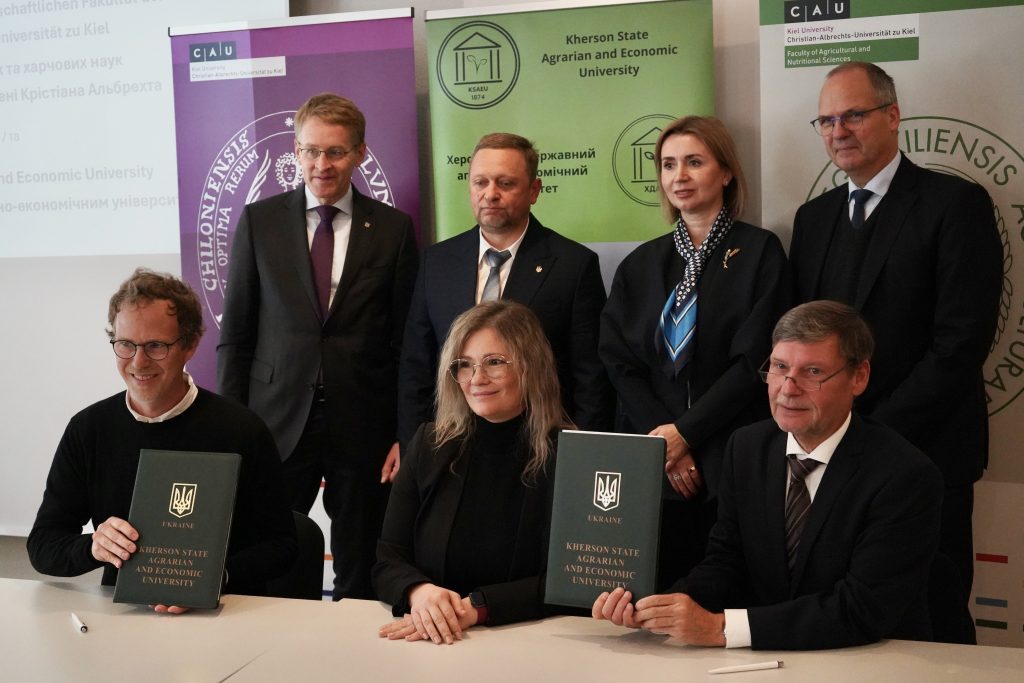
A broader framework for cooperation
The agreement builds on the universities’ cooperation through “Academic Cooperation and Teaching Initiative Kiel-Kherson” (ACTI-K²), a project within the German-Ukrainian Network of Universities (DUHN) supported by the German Academic Exchange Service (DAAD).
Prof. Dr. Kai Carstensen, Head of ACTI-K², opened the event. In his welcoming remarks to KSAEU’s delegation, he highlighted the critical importance of supporting Ukrainian academic partners during the ongoing war. “I am glad that the delegation was able to overcome such a difficult journey to join us here and continue our cooperation — now expanding into agricultural sciences”, said Prof. Dr. Kai Carstensen.
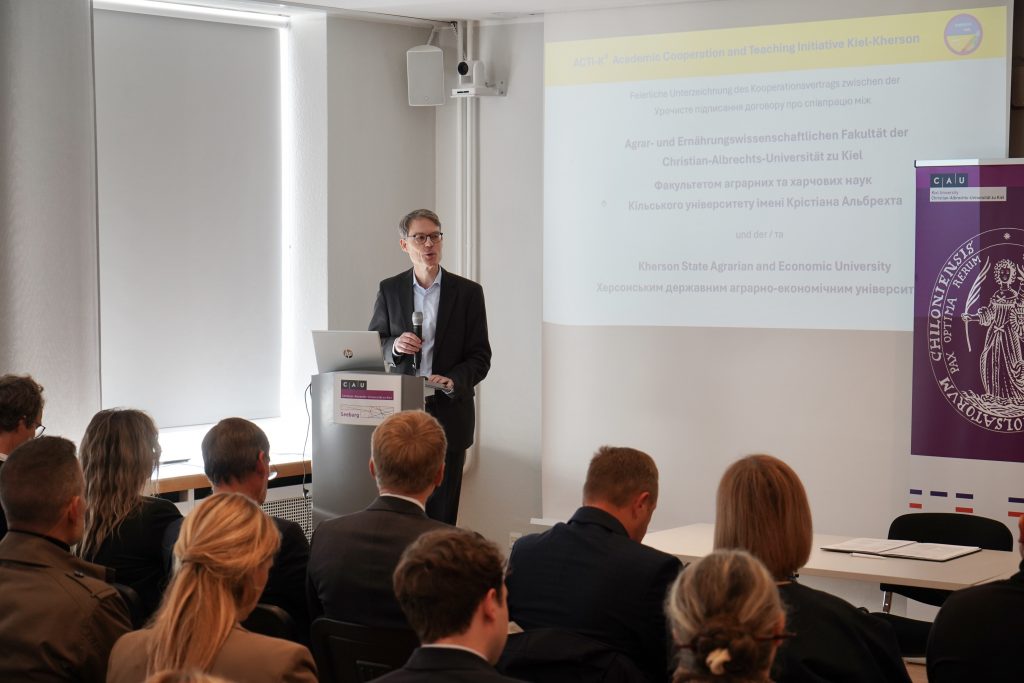
Support for the academic partnership
Prof. Dr. Viktoriia Hranovska, Vice-Rector of Kherson State Agrarian and Economic University (KSAEU), emphasized the importance of KSAEU’s participation in the project and the expansion of cooperation with Kiel University, especially in economics and agricultural sciences. She thanked her colleagues from CAU for their ongoing support, openness, and shared commitment to advancing education and research. “We are convinced that today’s agreement between the faculties will open new opportunities for joint research, training, and academic exchange,” said Prof. Dr. Hranovska.
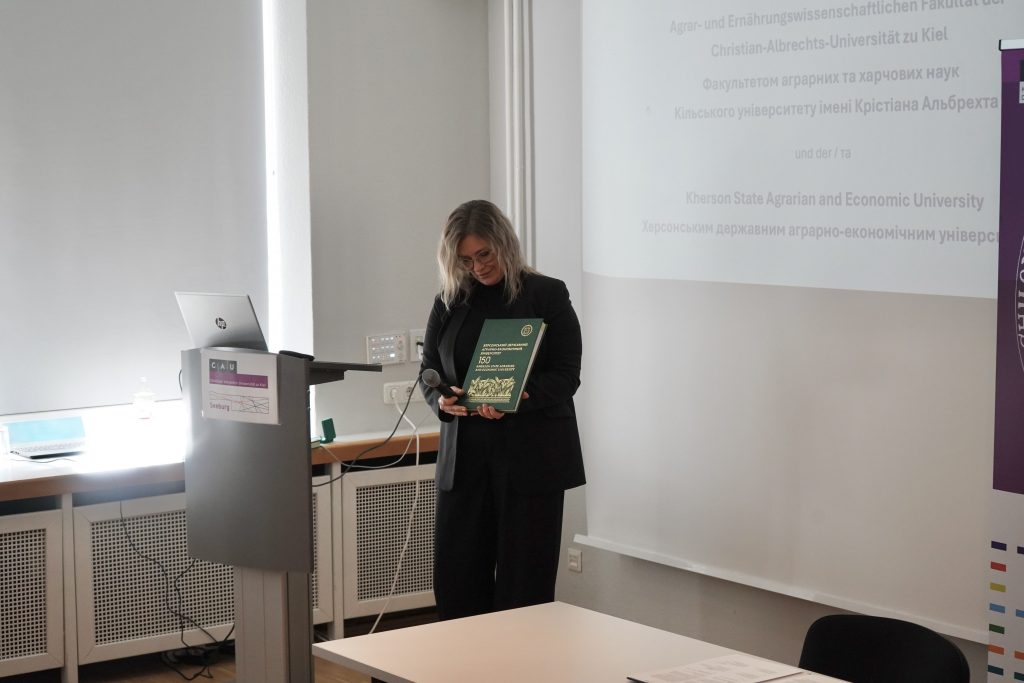
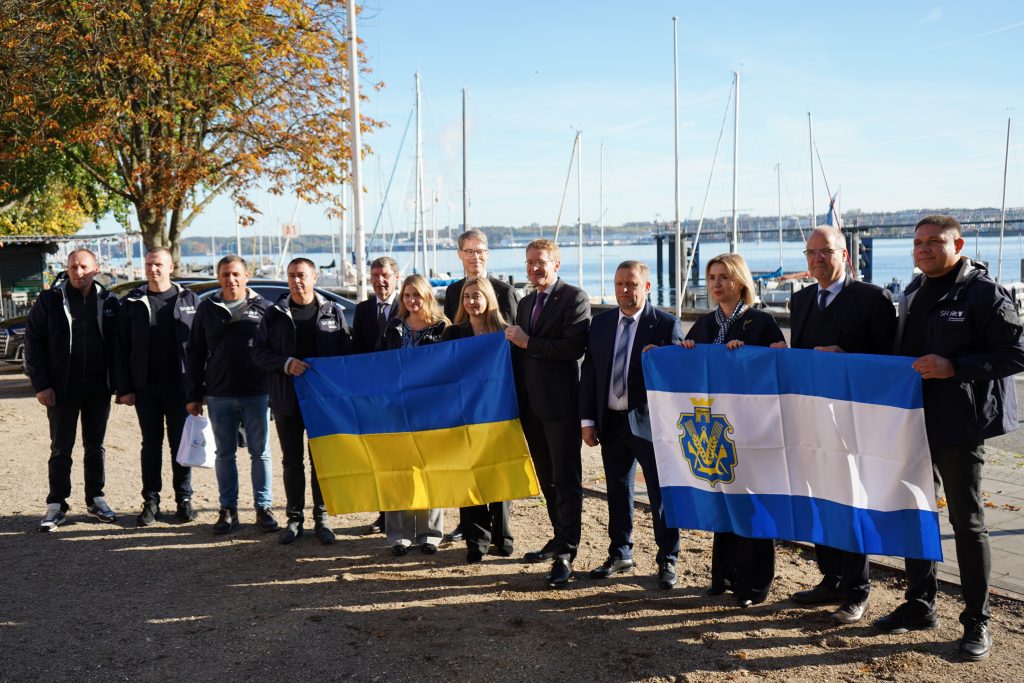
Guests included Daniel Günther, Minister-President of Schleswig-Holstein; Werner Schwarz, Minister of Agriculture; and Dr. Iryna Tybinka, Consul General of Ukraine in Hamburg. They expressed support for Ukraine and highlighted the partnership between Kiel and Kherson.
The ceremony was also attended by a delegation from Kherson region, led by First Deputy Head of the Kherson Regional Military Administration Dmytro Butriy, who noted the vital role of international cooperation in strengthening the region’s resilience and recovery capacity. “We are not alone on this difficult path — we feel support, and Kherson Region is deeply grateful to Germany for its solidarity and assistance”, emphasized Dmytro Butriy, First Deputy Head of the Kherson Regional Military Administration.
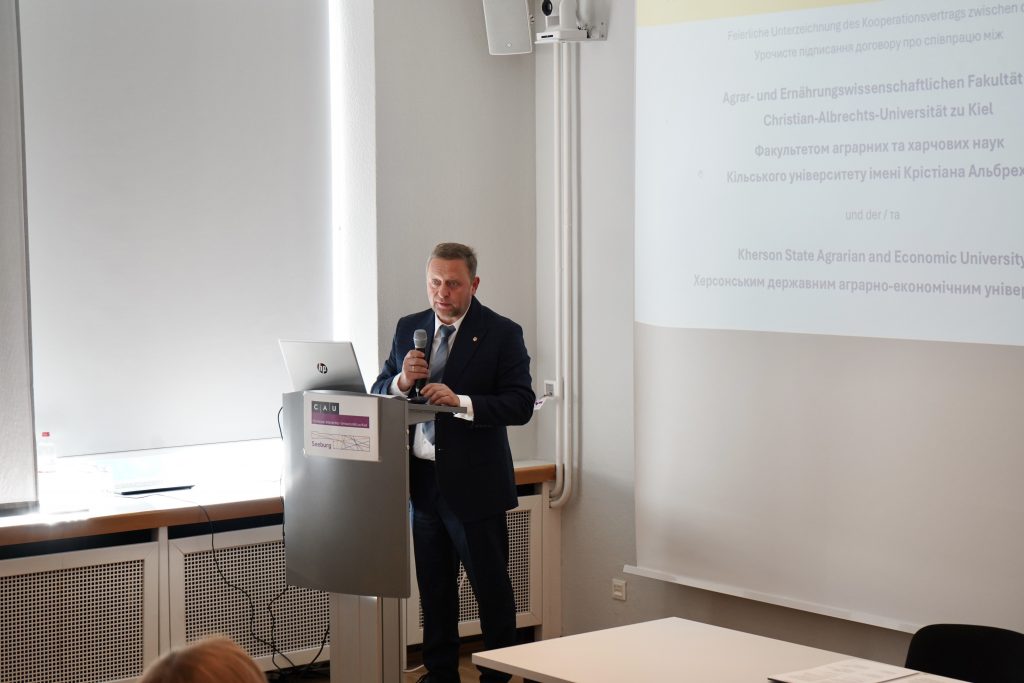
Agricultural research and future exchange
The MoU outlines cooperation in agricultural and nutritional sciences, with plans for joint research, academic exchanges, co-taught courses and seminars. Areas of interest include agricultural economics, sustainable farming and food technologies.
The universities’ cooperation began more than three years earlier through “Ukraine Digital: Ensuring academic success in times of crisis”. The new agreement expands this established teaching partnership into agricultural sciences.
The visit programme envisaged exchanges on agricultural production, agribusiness and the post-war recovery of the agricultural sector. KSAEU’s planned contributions covered land-use management, irrigation, crop productivity and sustainable farming technologies. CAU’s Faculty of Agricultural and Nutritional Sciences was to present research ranging from environmental management to agrotechnologies.
We thank the participating colleagues, the German hosts and partner institutions for supporting the visit and the expanded cooperation. ACTI-K² receives DAAD support with funding from the German Federal Ministry of Research, Technology and Space (BMFTR).
