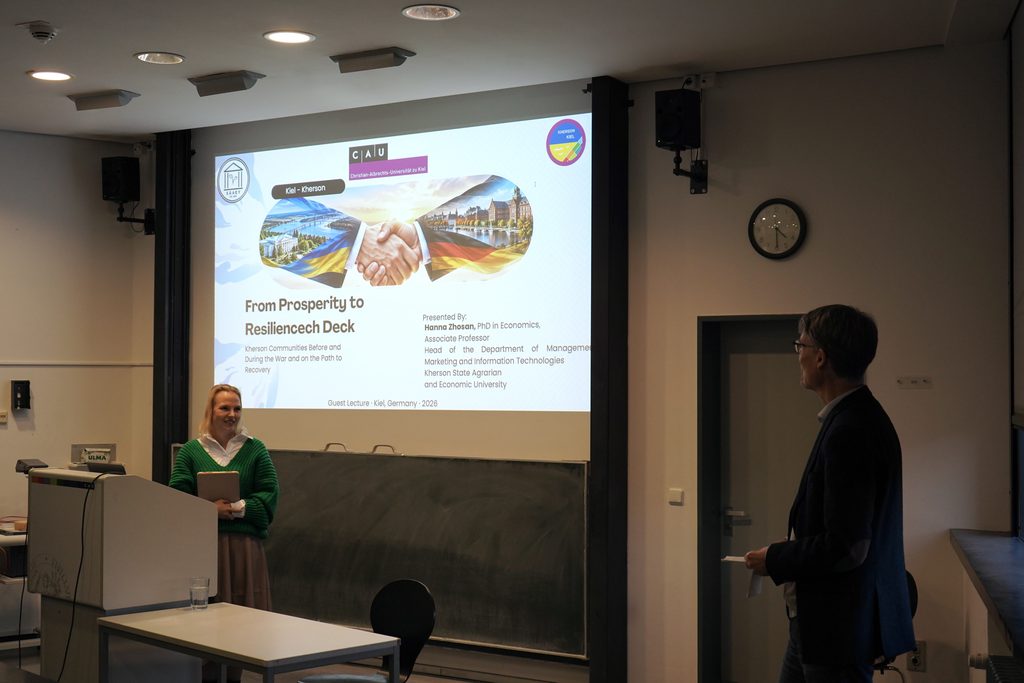
On 5 November 2026, Kiel University (CAU) hosted a guest lecture by Assoc. Prof. Dr. Hanna Zhosan, Head of the Department of Management, Marketing and Information Technology at Kherson State Agrarian and Economic University (KSAEU).
In her lecture in the Audimax, “From Prosperity to Resilience: Kherson Communities Before and During the War, and on the Path to Recovery”, she examined the effects of Russia’s war against Ukraine on the Kherson region and considered possible paths towards recovery.
Understanding the challenges facing Kherson
Assoc. Prof. Dr. Hanna Zhosan outlined the region’s economy before the war, highlighting the importance of agriculture and water infrastructure. She then examined how the invasion and occupation have disrupted communities, businesses, public services and agricultural production.
The presentation also addressed the destruction of the Kakhovka dam and its long-term consequences for water resources, irrigation and the environment. Alongside these challenges, she discussed the continuing risks to civilians and the importance of education, public services and community solidarity.
Building resilience and supporting recovery
Looking towards recovery, Assoc. Prof. Dr. Hanna Zhosan emphasised that rebuilding infrastructure is only one part of the task. Restoring access to services, retaining skills and strengthening local institutions are also essential.
Her presentation included an assessment of institutional capacity in 17 liberated communities, highlighting challenges in spatial planning, access to reliable data and the availability of trained staff. She also discussed why recovery strategies need to reflect the different needs and security conditions of individual communities.
As possible areas for future joint research, she presented water and environmental security, climate-smart agriculture, digital tools for spatial planning, institutional and economic resilience, and skills development and social recovery. Her presentation also outlined a proposal for a joint pilot project on evidence-based recovery planning for liberated communities in the Kherson region.
German-Ukrainian cooperation
Before the lecture, Prof. Dr. Kai Carstensen, ACTI-K² project leader, and Dr. Friedhelm Boyken, head of a coordination unit at the Schleswig-Holstein State Chancellery, gave introductory remarks. They addressed current challenges and emphasised the importance of German-Ukrainian cooperation. Their remarks set the wider context for the lecture and its discussion of Kherson’s resilience and recovery.
The lecture formed part of the project “Academic Cooperation and Teaching Initiative Kiel-Kherson” (ACTI-K²), within the German-Ukrainian University Network (DUHN). The project is supported by the German Academic Exchange Service (DAAD), with funding from the German Federal Ministry of Research, Technology and Space (BMFTR).
We thank Assoc. Prof. Dr. Hanna Zhosan for her lecture, Prof. Dr. Kai Carstensen and Dr. Friedhelm Boyken for their introductory remarks, and everyone who attended.
